 Vacation Tours of Ireland
Connemara: Mountains, Fjords and the Road West of Galway
Connemara is the western edge of County Galway, and this guide covers what to see there and how to fit it into a trip. It holds the Twelve Bens mountains, Connemara National Park with its Diamond Hill walks, Kylemore Abbey and its walled garden, the fjord at Killary Harbour and the small towns of Clifden and Roundstone. It is also Ireland's largest Gaeltacht, with roughly 20,000 to 24,000 native Irish speakers. The region is about 93 km from Galway city by road to the national park at Letterfrack, so a day trip is possible and a slower stay is better. Below you will find the facts, the walks, the abbey, the towns and the tours that reach Connemara, compared across Ireland vacation tours with honest notes on what each price covers. The bookable tours are compared on vacation tours of Ireland.
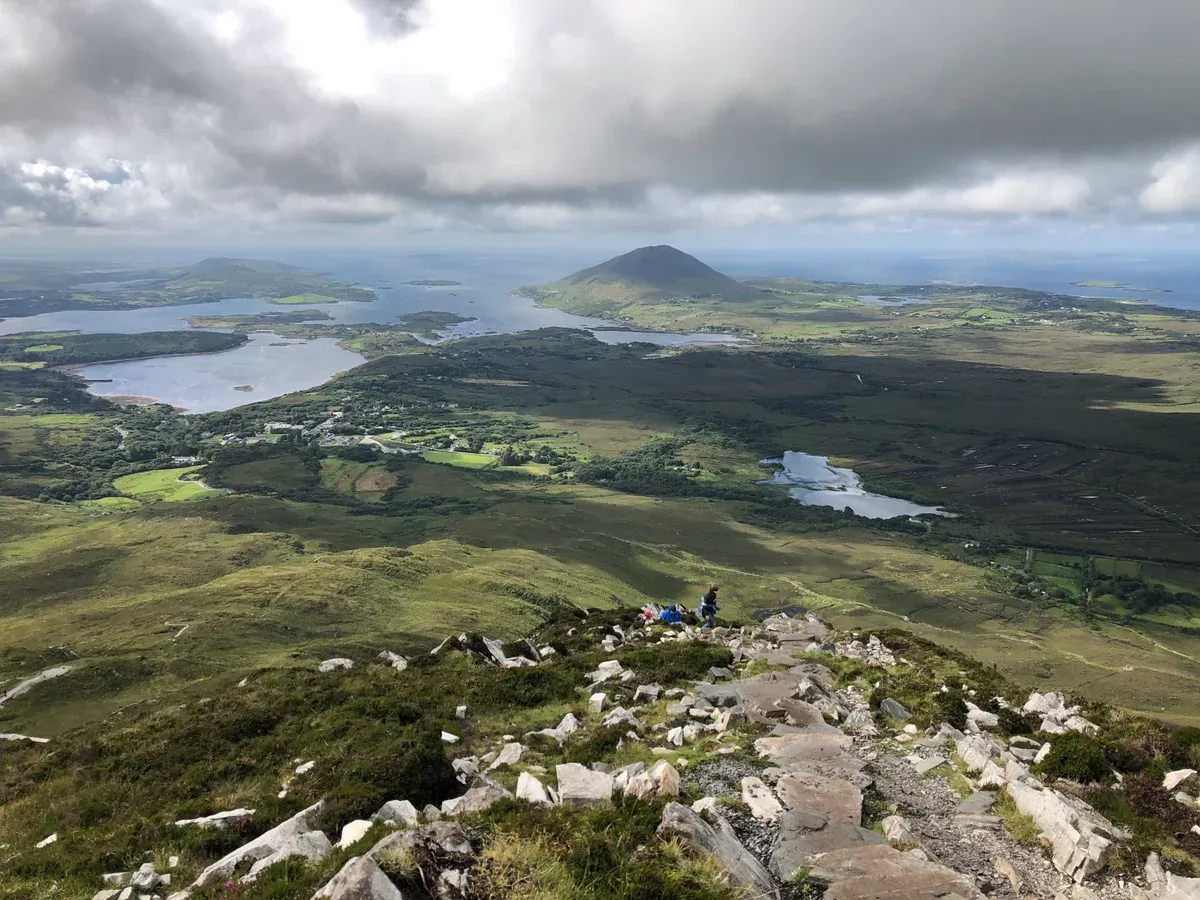
The lakes and hills of Connemara National Park from the Diamond Hill path. Photo: Karie Kuiper, CC BY-SA 4.0, via Wikimedia Commons
Quick answer Connemara at a glance
Connemara is the district of County Galway west of Lough Corrib and Galway city, covering about 2,000 hectares of national park near Letterfrack, roughly 93 km from Galway. It is famous for the Twelve Bens mountains, Kylemore Abbey, Connemara ponies and its Irish-speaking communities. Entry to Connemara National Park and its parking are free.
Key takeaways
- Walk the Diamond Hill trail in Connemara National Park: about 7 km and 2.5 hours round trip to a 442 m summit.
- Kylemore Abbey was built from 1867 for Mitchell Henry and its Victorian walled garden dates from 1870. See the history and garden.
- Several guided multi-day routes pass through, including the 10-Day Wild Ireland Tour and the 5-Day Northern Ireland Tour. Compare them all in the comparison table.
- Timing matters on the west coast. Read the best time to visit Ireland before you book.
Connemara at a Glance
The key figures for Connemara in one table, drawn from the national park service and standard references.
Key Facts and Figures
These are the numbers people ask for first: distances from Galway, the size of the park, the height of the walks and the depth of the fjord. All come from the National Parks and Wildlife Service page for Connemara and standard reference entries. Keep them at hand when you plan the drive or choose a tour.
| Fact | Figure |
|---|---|
| Connemara National Park area | about 2,000 hectares, opened 1980 |
| Park distance from Galway | about 93 km by road, near Letterfrack |
| Park distance from Westport | about 53 km |
| Visitor centre opening | Wednesday to Sunday 9:00 to 17:30, closed Mondays except bank holidays and all Tuesdays |
| Diamond Hill walk | about 7 km, 2.5 hours round trip, summit 442 m |
| Killary Harbour | glacial fjord 16 km long, about 45 m deep on average |
| Sky Road loop at Clifden | 11 km, climbing above 150 m |
| Native Irish speakers in Connemara | roughly 20,000 to 24,000 |
The Landscape and the Gaeltacht
Connemara is bounded by Killary Harbour to the north, Galway Bay to the south and the Atlantic to the west. The Twelve Bens give the skyline its jagged profile, with Benbaun as the highest peak, given as 725 m by the national park service and 729 m by Wikipedia. The Glencoaghan Horseshoe crosses six of the range over 16 km and takes 8 to 9 hours, which tells you how serious the ground gets for walkers.
Connemara is the largest Gaeltacht in Ireland. Irish is still the everyday language for many residents. The Connemara pony is the region's best-known animal. It stands 128 to 148 cm, its stud book began in 1923, and the story that the breed came from Armada shipwrecks is a myth. The Clifden pony show has run since 1924 on the third Thursday in August.
The ground itself yields Connemara marble, green from serpentine and formed about 460 million years ago. It is Ireland's national gemstone, but it weathers outdoors, so you see it in jewellery and interiors rather than buildings. If the marble pulls you west, note that Galway city, with 85,910 residents at the 2022 census, is the practical base. From there, several tours of Ireland fold Connemara into a wider loop, and the Wild Atlantic Way runs along its coast.
- Twelve Bens: Benbaun is the highest peak, 725 m or 729 m depending on the source
- Glencoaghan Horseshoe: 16 km, 8 to 9 hours, over six Bens
- Connemara pony: 128 to 148 cm, stud book since 1923
- Connemara marble: green from serpentine, about 460 million years old
The National Park and Kylemore Abbey
The two headline stops in central Connemara are the national park near Letterfrack and Kylemore Abbey.
Connemara National Park and the Diamond Hill Walks
Connemara National Park covers about 2,000 hectares and is run by the National Parks and Wildlife Service. Entry and parking are free, which makes it one of the best-value days anywhere on the west coast. The visitor centre, off the N59 near Letterfrack, opens Wednesday to Sunday from 9:00 to 17:30 and closes on Mondays except bank holidays and on all Tuesdays. There is a cafe, toilets and a playground.
Four marked walks start at the centre: the Ellis Wood Nature Trail, the Sruffaunboy Trail, the Lower Diamond Trail and the Upper Diamond Trail. Diamond Hill itself rises 442 m above Letterfrack and the main circuit runs about 7 km and 2.5 hours round trip, with a lower and an upper loop so you can turn back early. From the top you see the Twelve Bens, western Connemara and Kylemore Lough. Dogs are welcome on a lead.
The park holds more than scenery. A 19th century graveyard and megalithic court tombs about 4,000 years old sit inside its boundary, and the Connemara pony is its largest mammal. If you would rather leave the narrow roads to someone else, the 4-Day South West Ireland Tour passes through Connemara and Galway from Dublin for $568.20, and guides on driving in Ireland explain why many visitors choose exactly that.
Kylemore Abbey and the Victorian Walled Garden
Kylemore Abbey was built from 1867 and finished in 1868 as a private home for Mitchell Henry, a London doctor who later sat as MP for County Galway from 1871 to 1885. The castle, as it was first called, had more than 70 rooms including 33 bedrooms, behind a granite and limestone facade 142 feet wide. A Neo-Gothic chapel and mausoleum nearby remember Margaret Henry, who died in 1874.
The house changed hands fast after that. The Duke and Duchess of Manchester bought it in 1903 and sold it because of gambling debts. In 1920 Benedictine nuns who had fled Ypres in Belgium during the First World War settled here and ran a boarding school on the site until 2010. The Victorian walled garden was laid out by head gardener James Garnier in 1870, and restoration began in 1995.
Kylemore Abbey sits at 53.5617 N, 9.8894 W in Connemara. Check kylemoreabbey.com for the current admission price before you go. Several guided tours handle the entry for you: the 10-Day Wild Ireland Tour at $3,301 includes Kylemore Abbey entrance along with a two-night stay in Connemara, and the 10-Day Ireland Tour lists Kylemore Abbey and Gardens among its included admissions. If you are fitting the abbey into a longer plan, the 7 day Ireland itinerary shows where the west coast slots in.
Sources: National Parks and Wildlife Service, Wikipedia
Clifden, the Sky Road and Killary
The park and Kylemore draw the crowds, but Connemara is bigger than both. These are the towns, roads and waterways that fill out the rest of a visit.
Clifden, the Capital of Connemara
Clifden is Connemara's main town, about 77 km from Galway city by the N59. It had 1,259 residents at the 2022 census, so it is small, but it is often called the capital of Connemara and it works as the practical base for the region. John D'Arcy founded the town at the start of the 19th century. Its Irish name, An Clochán, means stepping stones.
Two bits of communications history sit nearby in Derrygimlagh bog. Marconi opened a wireless station there in 1907, and on 15 June 1919 Alcock and Brown crash-landed in the bog at the end of the first non-stop transatlantic flight. The town also hosts the Connemara Pony Show on the third Thursday in August, a fixture since 1924. For how Clifden fits into a wider route, see the Wild Atlantic Way.
The Sky Road
The Sky Road is an 11 km loop drive from Clifden around Clifden Bay and Streamstown Bay. It climbs above 150 m, with views of Clifden Castle and, on clear days, the island of Inishturk. It is short enough to fit into half a day, and most of a Clifden visit comes down to this loop plus the town itself.
The roads out here are narrow and winding, so take the loop slowly and expect oncoming traffic. If you plan to drive any of this yourself, read the guide to driving in Ireland first. A coach tour takes the worry of the narrow sections away, and the itineraries below handle the route for you.
Killary Harbour and Leenaun
Killary Harbour is a glacial fjord 16 km long and about 45 m deep on average, running along the border between County Galway and County Mayo. Mweelrea, at 814 m, rises on the Mayo side, while the Twelve Bens and the Maumturks stand on the Galway side. Mussel rafts float on the water, and catamaran cruises run April to mid-October.
Leenaun, also written Leenane, sits on the southern shore near Aasleagh Falls. The village was the setting for the 1990 film The Field.
Roundstone
Roundstone, Cloch na Rón in Irish, meaning seal's rock, is a village on Connemara's west coast with a reputation for the arts. It sits on Connemara's west coast, so it pairs naturally with a Clifden stay.
Treat it as a stop to wander rather than a schedule of sights, with its arts reputation as the draw.
The Twelve Bens
The Twelve Bens are Connemara's mountain range, with Benbaun as the highest peak. Sources disagree on its height, giving 725 m per the national parks site and 729 m per Wikipedia, so quote either with care. Serious walkers take on the Glencoaghan Horseshoe, a 16 km route over six of the peaks that takes 8 to 9 hours.
That horseshoe is a full day's commitment for fit hikers with mountain experience, not a stroll. For most visitors, Diamond Hill in the national park is the more sensible summit, as covered earlier on this page. The mountains are best seen rather than climbed if your time is short.
The Connemara Pony and the Gaeltacht
The Connemara pony is the region's best-known animal. It stands 128 to 148 cm, its stud book began in 1923, and it is the largest mammal found in Connemara National Park. The romantic story that the breed descends from horses swimming ashore from Spanish Armada shipwrecks is a myth, so enjoy it as a story only.
Connemara is also the largest Gaeltacht in Ireland, with roughly 20,000 to 24,000 native Irish speakers. You can hear Irish spoken around the region. The west end of the Dingle Peninsula is another Gaeltacht, and the Dingle Peninsula guide covers that one. One more local material to know: Connemara marble, green from serpentine and formed about 460 million years ago, is Ireland's national gemstone. It weathers and loses its colour outdoors, so it is used for jewellery and interiors rather than building.
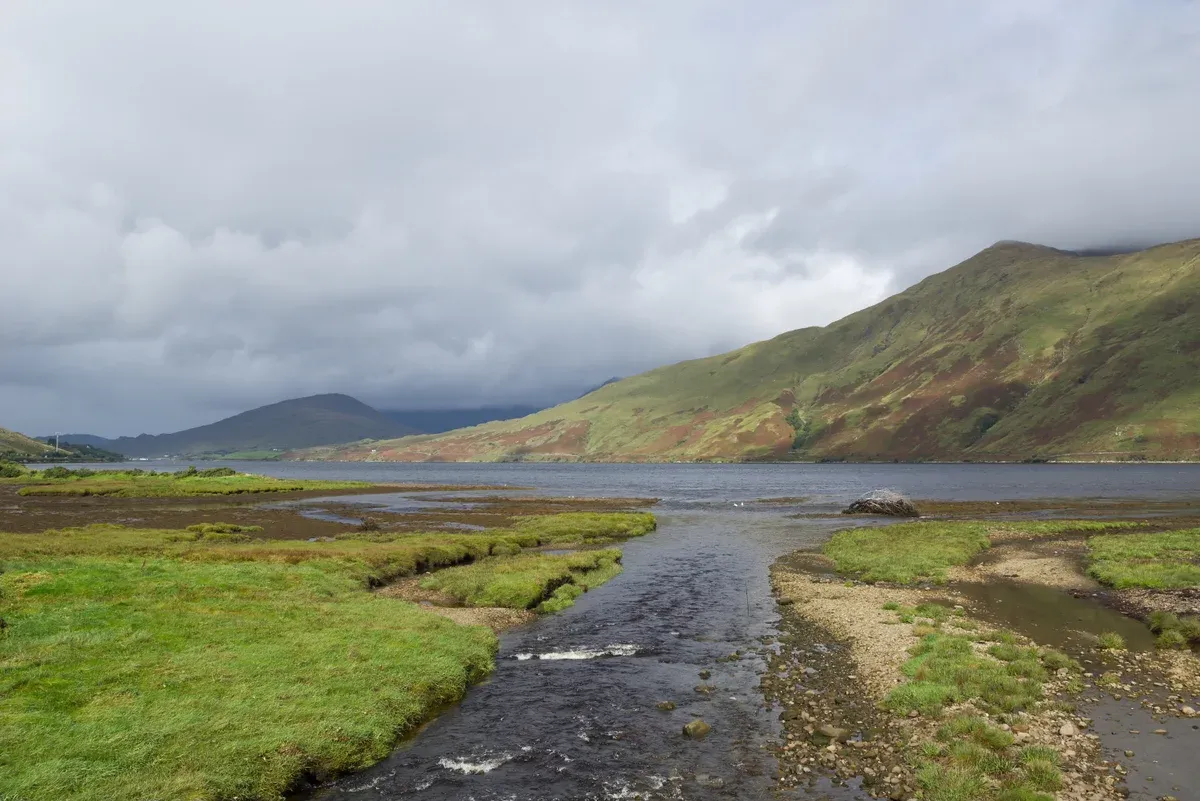
The head of Killary Harbour with mountains on its far shore. Photo: Berthold Werner, CC BY-SA 4.0, via Wikimedia Commons
Getting There and the Tours That Go
Connemara has no rail line, so everything comes down to road distance from Galway, a limited bus network, or a guided tour that does the driving for you.
Distances from Galway
Galway is the natural gateway, with 85,910 residents at the 2022 census and a compact centre worth an hour or two itself. The drive from Galway to Letterfrack and Connemara National Park is about 93 km by road, and Clifden is about 77 km from Galway by the N59. Coming the other way, the park is about 53 km from Westport in County Mayo, so Westport works as a second base.
If you hire a car, those three distances let you plan a full loop: Galway to the park, on to Clifden, back through Roundstone, or over to Leenaun and Westport. Without a car, the options narrow, which is why many visitors take a tour. The multi-day options are compared in full on the homepage at the comparison of Ireland vacation tours, and the table below pulls out the ones that reach Connemara.
Buses and Coaches
There is no railway into Connemara, so public transport means bus. Check current timetables directly with the operators before relying on a bus day trip. The distances are about 93 km from Galway to the national park and about 53 km from Westport.
Practically, that means a self-organised day by public transport is tight, because the park's visitor centre closes at 17:30 and is shut all Tuesdays and Mondays except bank holidays. A rental car or a guided tour uses the hours far better. If you are building a longer route around the west, the 7 day Ireland itinerary shows where Connemara fits.
Guided Tours That Include Connemara
The table compares the multi-day tours in the listings that put Connemara on the route, with the days and the price each card shows. Note what the price covers: on the 10-Day Wild Ireland Tour, Kylemore Abbey entrance is included, while on the 5-Day Northern Ireland and Atlantic Coast tour, admission fees are not included. Breakfast is included on all the tours listed, and lunch is not listed as included.
The full side-by-side comparison lives on the homepage.
| Tour | Connemara on the route | Days | Price |
|---|---|---|---|
| 10-Day Wild Ireland Tour | Two-night stays in Connemara, Kylemore Abbey entry included | 10 days, 9 nights | $3,301 |
| 10-Day Ireland Tour | Galway region, Kylemore Abbey and Gardens entry included | 10 days, 9 nights | $3,917.02 |
| 5-Day Northern Ireland Tour | Atlantic coast through Mayo and Connemara, two nights in Westport | 5 days, 4 nights | $1,486.20 |
| 4-Day South West Ireland Tour | Route through Connemara and Galway | 4 days, 3 nights | $568.20 |
Sources: Connemara National Park, Wikipedia: Connemara
Where to Sleep in Connemara
Each link opens the live room list. Clifden is the main town inside Connemara, Galway the city base on its edge.
Clifden
- Suits
- The Sky Road, the national park and Kylemore in short drives
Clifden is the main town of Connemara.
See stays in ClifdenGalway city
- Suits
- Day trips into Connemara by tour or bus
Connemara starts west of Lough Corrib and Galway city.
See stays in Galway cityConnemara Questions
Why is Connemara famous?
Connemara is famous for its mountains, for Connemara National Park and Diamond Hill, for Kylemore Abbey, for the Connemara pony with its stud book dating to 1923, and for being Ireland's largest Gaeltacht with roughly 20,000 to 24,000 native Irish speakers. Its green Connemara marble, formed about 460 million years ago, is the national gemstone.
Is Connemara worth a visit?
Yes, if mountains, fjords and a walled garden appeal. The national park is free to enter, Diamond Hill is a 7 km walk of about 2.5 hours round trip, and the Sky Road adds an 11 km scenic loop from Clifden. See the Connemara highlights above for how to spend the day.
Is Connemara a horse or a pony?
It is a pony. The Connemara pony stands 128 to 148 cm, and it is the largest mammal in Connemara National Park. The claim that the breed came from Armada shipwreck horses is a myth.
Is Connemara marble worth anything?
It is Ireland's national gemstone, green from serpentine and about 460 million years old, and it weathers outdoors so it is used for jewellery and interiors. To budget the trip, use the Ireland trip cost guide.
How do I get to Connemara from Galway?
By road, along the N59, about 93 km from Galway to Letterfrack and the national park and about 77 km to Clifden. There is no railway. Check bus timetables with the operators, or drive or take a guided option such as the 5-Day Northern Ireland Tour, which runs the Atlantic coast through Mayo and Connemara.
Which tour should I book for Connemara?
The pick is the 10-Day Wild Ireland Tour, because it is the only listing with two-night stays in Connemara and its price includes Kylemore Abbey entry, along with the Cliffs of Moher, Rock of Cashel, Glendalough and Cahir Castle. For shorter budgets, the 4-day South West tour passes through Connemara from $568.20.